

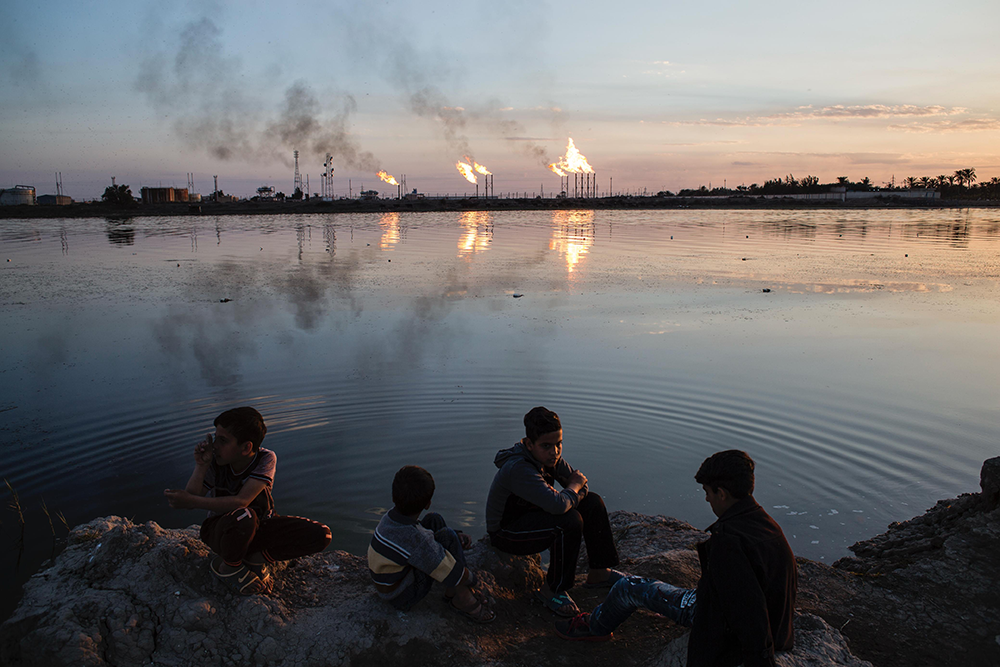
When poverty, migration, climate change, war not only push themselves to the forefront of our visual field but embed themselves in our imaginations, in our social fabric, how can we begin to picture the effects? What happens to our moving image? To filmmaking?
It is these questions, in one way or another, that the 25 projects that make up this year’s AFAC Cinema Grant take up as they turn their camera onto complex dramatic scenes of their own making but drawn from the realities of the filmmakers.
Excursions into genre, breaks with conventional themes and storytelling, but most of all, an unflinching look at the hazy, darkness that is our future, there is all of this and more in a diverse and cogent group of short and long-form films. They stretch from a small Kurdish town being incorporated into a neighboring oil field to a small Moroccan city of Mohammedia where a young fisherman sees the full moon crack in two.
And as much as the films are doing something new with the image, with memory, with documentation, they each have at their core strong narrative propositions.
Lightning makes the rock dreams of a young Palestinian boy come true but at a cost.
A quest for a video game forgotten in a house now occupied by the RSF brings a strange friend for a young Sudanese boy: a teenage sniper on the opposite side of the brutal conflict.
A gifted camera carries within it images that a Syrian man in Berlin thought he had left behind.
To make the 25 selections, two jury committees evaluated the 2025 cinema cycle submissions. One focused on shorts, and another on feature-length films.
The short films jurors consisted of Lebanese filmmaker Nour Ouayda, Egyptian film producer Muhammad Taymour and Saudi film critic Ahmed Elayyad.
While the feature films jury was composed of Lebanese executive director and programmer of Metropolis Hania Mroue, Algerian director Karim Moussaoui and Syrian film director and writer Nidal Al Dibs.
Following their deliberations, the jury committees issued the following statements:
Short films jury statement
-
The jury expresses its deep appreciation for all the films submitted this year. The submissions were notable for their remarkable diversity of theme, style and vision.
The works displayed boldness in what they put forward and in their innovation in form and content, reflecting the vitality of the film landscape in the Arab region, from its far east to its far west.
Projects that broke away from familiar molds to pose daring questions about current social and political realities and to explore concepts of memory and documentation through unconventional means were of particular interest to the jury. These tendencies reflect the contours of cinema in the Arab region; a cinema rich in experience, seeking in imagination a space to engage with reality and its burdens.
Selecting the finalists was both a demanding and an inspiring task, given the richness, diversity and strength of the submissions. We would like to emphasize that the decisions we made take into account, alongside artistic considerations, various production and strategic factors that contribute to a project’s success and sustainability.
Lastly, we encourage filmmakers to hold on to their passion and determination, to continue searching for alternative paths to funding and production and to maintain an unwavering belief in cinema’s ability to renew itself, adapt and open new horizons for creative expression.
Feature films jury statement
-
The jury thanks AFAC for its important role in supporting cinema in the Arab region and congratulates the awarded filmmakers, wishing them success as they complete their projects.
We also extend our appreciation to all the filmmakers who submitted their work, work that reflects their creative ambition and determination to forge a new cinema in the Arab region despite the many challenges facing artistic practice in our region.
The harsh and complex realities the Arab world has been living through — particularly over the past 15 years — have pushed filmmakers to seek broader spaces of expression in new artistic forms and to articulate the social, political and psychological burdens of the individual as part of the wider human burden, surpassing the boundaries, norms and prohibitions that stand in the way.
In the projects reviewed, the jury felt a desire among filmmakers to break free from the constraints of the mainstream — both in form and content — and to engage directly with dominant concepts and institutions that are held as sacrosanct, whether that be the state, the homeland, the family, the religious establishment or any prevailing ideological system.
This drive was evident in the adoption of genres that are not commonly seen in cinema in the Arab region — science fiction, thriller, fantasy or horror — and how the projects venture into new spaces that range from the harshness of exile to the cruelty of the city and its poverty belts and move southward to the marginalized countryside and forgotten deserts. These ventures were driven not by nostalgia for the past or attempts to depict present realities, but by a desire to confront a future that often appears hazy, dark and, at times, apocalyptic.
The jury expresses its hope and confidence that the filmmakers’ pursuit of a broader artistic and thematic field will open new horizons and possibilities for what film in our region can mean and for the artistic and human role it can play.
The projects selected by the jurors
- Songs From the City of the Dead by Abdelwahab Shawky, Egypt
- The Lost City of Atlantis by Samir Benyala, Algeria
- Moondust by Ahmed Essam, Egypt
- The Night Of by Bane Fakih, Lebanon
- The Arab Apocalypse by Samy Sidali, Morocco
- The Blooms by Sama'an Ashrawi, Palestine
- Eternal Peace by Fyzal Boulifa, Morocco
- Solastalgia by Yosr Gasmi and Mauro Mazzocchi, Tunisia
- Getting my Ex-Husband's Skull Back by Beshoy Youssef, Egypt
- Occupational Hazards by Bassel Ghandour, Jordan
- Kafr el Dawwar - Athens by Mahmoud Ibrahim, Egypt
- Speak by Nejib Kthiri, Tunisia
- Last Trip by Ziad Kalthoum, Syria
- Rabies by Sandra Tabet, Lebanon
- Shiny Bones by Clara De Gobert, Lebanon
- Weedestine by Said Zagha, Palestine
- Plague by Youssef Chebbi, Tunisia
- Dino's Last Day by Rayane Mcirdi, Algeria
- The Day I Danced with My Father by Sameh Alaa, Egypt
- Every Stone Has Its Place by Osame Anwer, Iraq
- Dukhry by Khaled Alwaleed, Sudan
- Blue Card by Mohammed Alomda, Sudan
- A Quoi Revent Les Maknines? (What Do Maknines Dream of?) by Sarra Ryma Kherrat, Algeria
- Safe Exit by Mohammed Hammad, Egypt
- Anza by Amine Hattou, Algeria