

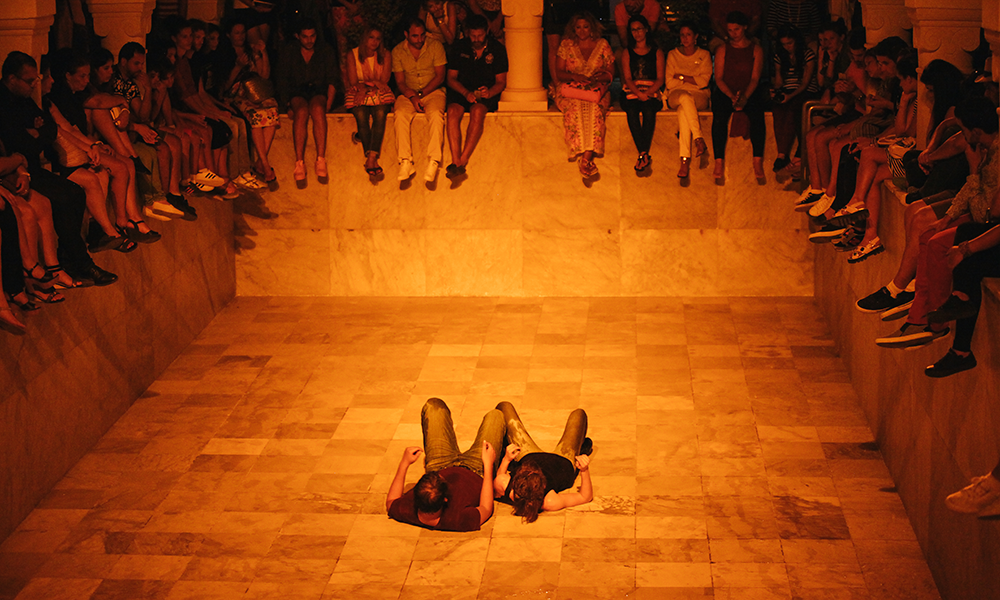
AFAC allocates US$900,000 in grant support to 13 projects with circulation and connectivity at their core.
How can we make sure our ideas, projects, films, and solutions travel, in a world where border restrictions and censorship limit our ability to commune with one another?
The Creative Caravans Festivals and Touring Projects pillar, under the Ecologies of Culture program, supports the infrastructure and people that allow our ideas to travel and that allow us to see and think about art and culture, through residencies, festivals, cultural events, and regional exhibitions that tour and disseminate artistic and cultural works. Whether digital or physical, intimate or public, what matters is the projects’ ability to move — across borders, languages, communities, or platforms — and to carry with it a sense of shared urgency.
While circulation and connectivity are central to all projects, they take shape through a wide range of themes, approaches and formats. Some of these explore topics such as pastoral life and the politics of milk in Palestine and Morocco; Algiers’ sonic landscape; and plants and other species as living witnesses to their own history, and the history of the place they are rooted in. Others explore formats, such as a curated tour of environmental films across Lebanon and the region, a traveling arts festival circulating in the 24 Tunisian governorates, and a touring exhibition featuring creative works related to detention and enforced disappearance in Syria.
This selection was made by the Creative Caravans/Festivals and Touring Projects jury committee — comprised of Geoliane Arab (Lebanon), a cultural practitioner, Brahim El Mazned (Morocco), a cultural manager and founding director of Visa for Music, Amer Shomali (Palestine), a multidisciplinary artist, Faten Jaouadi (Tunisia), production and distribution officer at the Tunisian National Theater, and Ahmed Sobky (Egypt), head of distribution at Film Clinic Indie Distribution. At the close of their deliberations, jurors issued the following statement:
-
“The jury reviewed the applications to the Creative Caravans pillar of AFAC’s Ecologies of Culture program at a time when movement itself — across borders, between cities, and between villages and capitals — cannot be taken for granted. Many of the caravans, tours, and itinerant programs described in these applications were designed to operate in regions affected by war, displacement, and economic pressure. Reviewing them together, the jury found that the central question was not only what these projects would carry from place to place, but what it means to insist on movement — on meeting, exchange, performance, and gathering — at a time when the conditions for doing so are especially difficult.
The jury observed that a large number of applications chose to move away from capital cities. Instead of concentrating their activity in Beirut, Cairo, Casablanca, or Tunis, these projects proposed working in other cities, rural markets, refugee camps, and villages that have historically been left outside cultural infrastructure, bringing performances and exhibitions to rooftops, courtyards, and community spaces rather than waiting for audiences to come to established venues. It was also striking to note the number of projects touring across multiple countries, opening a wider space for the cross-border movement of artworks and reaching diverse communities within the region. This same move away from centralization also appeared in the content of the projects: applications repeatedly returned to land, water, markets, and plant life as sites of memory and forms of resistance, treating the built and natural environment as an archive under threat. In this sense, many of the project sites were not simply a backdrop to movement, but formed their core artistic and intellectual substance — connecting local experience to broader questions such as environmental change, resource loss, and communities' claims to their land and memory.
Several recurring approaches stood out within this pattern. Some projects built touring residencies, treating exchange as an ongoing practice rather than a single event. Other projects worked to keep disappearing infrastructure — a market facing redevelopment, a coastline, an old tram line — active as a site of cultural production, rather than only documenting it after it disappears. A number of projects also reactivated archives of loss and disappearance, using them as material for dialogue with audiences encountering this history for the first time, rather than as fixed memorials.
The jury also noted that these projects are often carried by small, recently established collectives, and by teams led by women and young people, with limited institutional capacity. Several of the strongest artistic proposals came from groups founded only a few years ago, where administrative capacity has not yet caught up with the ambition and maturity of their artistic work. The jury weighed this gap case by case. In most instances the gap is read in context, as a feature of how urgent, responsive cultural work is currently produced in the region, often by those closest to the communities it serves. In a small number of cases, this gap — alongside other factors — did contribute to the disqualification of some projects.
One point raised during the jury's deliberation was the value of partnerships that had already been tested through prior collaboration, rather than assembled only for the purpose of the application. Jury members also discussed the importance of teams being able to explain concretely how they would continue their work if the roads, borders, or venues they had planned around were closed. Artistic ambition mattered, but so did the ability to adapt: a number of selected projects had built alternative plans into their design from the start, treating disruption as a condition to plan for rather than only as a risk to avoid.
The jury also noted that, across the selected projects, there was a balance between more conventional approaches to cultural work and projects that take a bolder approach, questioning cultural practices themselves in how they engage with the issues they address. The jury saw this diversity as valuable in itself, not as a tension to be resolved in favor of one approach.
Throughout the review process, the jury was struck by how consistently these projects continued their work despite difficult surrounding conditions. Together, the selected projects present a picture of communities across the region that insist on continuing to move their stories, their art, and their people from place to place, even when this movement requires real effort and courage.”
Meet the selected festivals and touring projects:
- SuperMelon, Black Goat Festival: On the Politics of Milk, Palestine
- The Wonder Cabinet, Sounds of Places 2026-27. How Do We Sound Together?, Palestine
- Beirut Physical Lab, Arab Dance Platform, Lebanon
- Studio Chimbo, Les itinérants are calling, Algeria
- Rumman, Hijaz Trail, Lebanon
- REEF Association, The Land and its Keepers: Images and Conversations, Lebanon
- Harvest Festival Marrakech, Ecologies of Care, Morocco
- Al Badil - L'alternative culturelle, Hors-Lits Tunisie - Une Décennie de Création, Tunisia
- Creative Memory - Images de l'Orient, Traveling Exhibition: Detainees and Disappeared - Art Documents and Archives Speak, Syria
- Studio 8, Art in Motion, Jordan
- Two.Five, Satellites of Arab Cinema, Egypt
- Seeds of Doubt, Seeds of Doubt, Egypt
- Le Carrefour des Culturel(le)s, AMANAR, Industry & Development Program, Morocco