

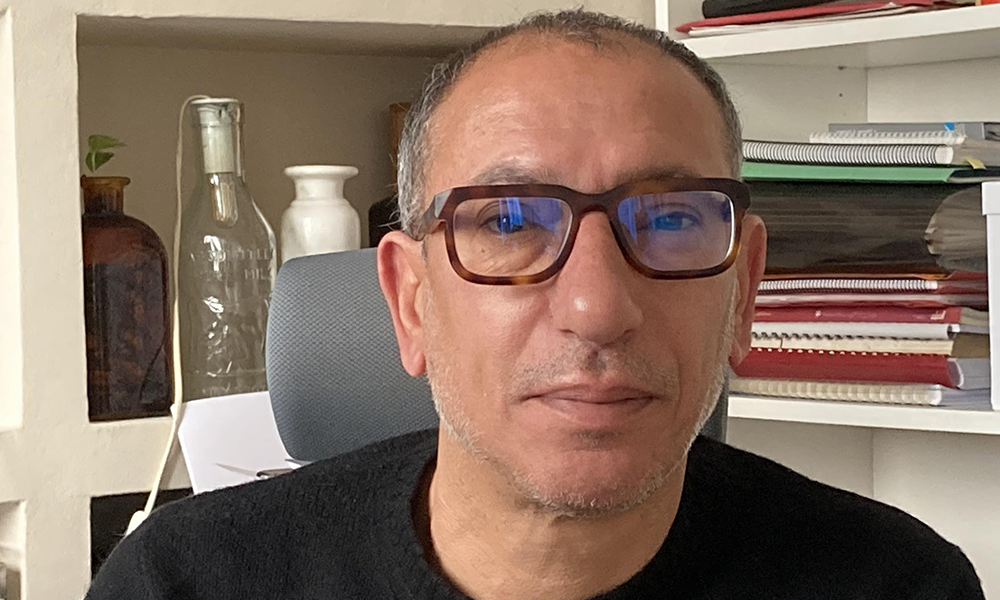
Director, Writer & Film Educator, Egypt
“We are living at a time when ruling political classes and forces are trying to normalize ignorance.”
Basel Ramsis, Egyptian director, writer, and film educator, believes that making art is part of everyday life. It is a way of inhabiting it, questioning reality, developing a position towards it, and sometimes intervening in it.
“Arts and culture are a way of life, far beyond being a profession,” he says. “It is not a question of the artist or intellectual giving ‘awareness’ to an audience. The artist develops a point of view and a position through the process of making the work, and through the audience’s interaction with it.”
That relationship between cultural production and political reality sits at the heart of Ramsis’s practice, and informs what he sees as the most urgent challenge facing artists and cultural practitioners in the region.
“The greatest challenge for intellectuals and artists in the Arab world today is the complete absence of democracy,” he says, describing a period of severe political and social repression in which spaces for independent and free cultural production are increasingly constrained.
For Ramsis, these pressures cannot be separated from the wider global context: war, genocide, the rise of far-right and fascist movements, and political forces that increasingly normalize repression and inequality. What happens beyond national borders, he argues, inevitably shapes everyday life and, with it, the possibility of producing independent art and culture.
His response is not to avoid these conditions, but to engage with them.
“We are living at a time when ruling political classes and forces are trying to normalize ignorance,” he says. “So, at the very least, we have to speak, to struggle, to engage—and perhaps sometimes to shout—through every medium available to us, artistic or otherwise.”
That conviction runs through Ramsis’s AFAC-supported project, Qinawi’s Last Scream “I Will Show You!”. Youssef Chahine’s Progress in Self-reflection and Ways of Storytelling, 1950-2007, a 500-page book examining the cinematic trajectory of Youssef Chahine.
Ramsis began working on the book during the COVID-19 pandemic, at a moment when he felt that “the old world was ending”, signaling that the time was right to embark on this project.
“If the old world was ending, then we had to hold on to its brightest aspects and learn from them in order to confront a new world that would be harsher,” he recalls.
That impulse led him back through more than fifty years of Chahine’s cinema, to examine the filmmaker’s body of work, and to explore the political, social, and cultural transformations of Egypt and the wider region through it.
Throughout the book's chapters, Ramsis explores the changing role of the intellectual and filmmaker in Arab society through Chahine’s cinema. One of the defining moments of the project was the completion of the chapter titled: The Intellectual Laid Bare… In front of Power and Public. Ramsis recalls how Chahine used cinema to peel back the layers of the Arab intellectual elite, exposing their vulnerabilities, moral dilemmas, and complex relationships with political authorities and the general public.
“It addresses a concern that is fundamental to me: the position of the intellectual or artist in relation to people, to power, to what is happening in their society, and to everything surrounding them.”
At the same time, Ramsis uses Chahine’s cinema to propose new critical frameworks that remain underdeveloped in Arabic-language film studies, including the concept of “self-referential cinema.” In this sense, the book’s subject and Ramsis’s own concerns begin to converge. Looking at Chahine becomes a way of asking a question that remains unresolved: what responsibility does an artist have toward the world in which they work, and what is their stance on its issues and crises—even if the primary material of their work consists of their personal experiences?
AFAC’s Creative & Critical Writings grant provided an important incentive to move that inquiry toward completion.
“The grant was necessary as a motivation to work, a push forward and toward completing it,” Ramsis says. “Perhaps it also created a kind of recognition and anticipation around the book, and subsequently interest from publishing houses.”
The book was published in 2025 by the Cairo-based publishing house Kotob Khan Publishers and contributes to the expansion of the critical literacy available for thinking and writing about cinema in Arabic.
At a moment when Ramsis sees the space for independent cultural thought narrowing, the act of writing carries its own significance.
Revisiting a cinematic legacy becomes a way to interrogate the present. Developing critical language becomes a way to resist intellectual stagnation, while preserving space for disagreement, analysis, and engagement becomes part of cultural practice itself.
For Ramsis, art does not stand outside reality to contemplate it from a distance, rather, it is a product of reality itself, a part of it.
This engagement with reality through artistic tools allows us to see it, understand it, and perhaps even change some of its features.