

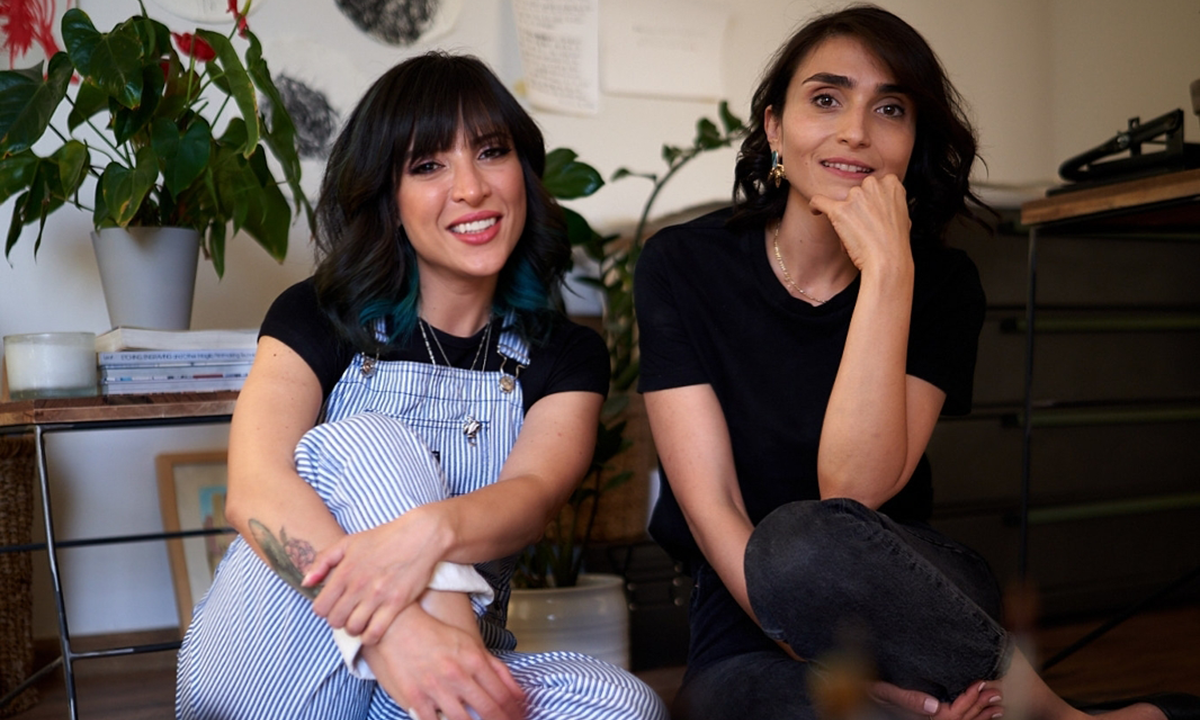
Co-Founders of Alolbah, Jordan
“Arts and culture thrive through access.”
Jordanian educators and artists Laila Demashqieh and Rand Abdul Nour identified a structural gap in art education outside formal institutions. Especially for women, the challenge was never a lack of creativity, the challenge was access.
Through years of working in education, they noticed many women had the desire to create, learn artistic techniques, and explore their creativity, but lacked access to the resources, confidence, or the supportive environments needed to begin.
Rather than designing one-off workshops, they began asking a different question: What would it look like to build a learning system that could travel from one woman to another, continuing after the workshop itself had ended? The answer became Alolbah.
Named after the Arabic word for "box," Alolbah combines art materials, a curriculum, and practical guidance into a portable learning tool designed to move through communities. Women learn artistic methods, develop creative thinking skills, and eventually share that knowledge with others.
“We wanted women to experience art-making themselves,” explains Rand. “But we also wanted them to learn how to teach art and pass that knowledge on.”
What began as a simple idea has since evolved into a growing community of over 600 women and girls across Jordan. The project has expanded organically as participants introduced daughters, friends, and neighbors to the workshops. In many cases, the box itself became something more than a learning tool.
“One of the things we hear most often,” says Laila, “is that women usually buy things for their children, but rarely for themselves. Because of that, the box is often perceived as a gift.”
Yet, the impact extends well beyond artistic skills. Through Alolbah's workshops, participants are encouraged to question assumptions, experiment freely, and move beyond the fear of making mistakes. Women who initially hesitated to pick up a pencil gradually developed the confidence to create, critique, and share their work with others.
“We try to break that internal voice that says, ‘I have to make a masterpiece,’” Rand explains. “Participants begin to realize that art does not have to be perfect to have value.”
Over time, that confidence has translated into leadership. Some participants have gone on to facilitate workshops themselves. While others have launched initiatives of their own. Informal WhatsApp groups created during workshops continue to function as learning networks, where women exchange ideas and support one another even after the formal sessions end.
“What begins with fear eventually turns into laughter and a strong bond,” says Rand. “It truly becomes a community.”
One moment remains especially meaningful for the founders. After completing the program, a participant sent them a message explaining that she was preparing to lead her own workshops.
“It is difficult to describe how we felt when we read that message,” recalls Laila. “Some of the women who were initially the most hesitant were the very ones who later began leading workshops themselves.”
Building and sustaining such a model has not been without challenges. Funding, logistics, and persistent perceptions of art as merely a hobby continue to shape the project's development. Many participants balance family responsibilities, long commutes, and social expectations that can limit their ability to engage consistently.
For this reason, adaptability became central to the project's design. Laila and Rana received a Visual Arts grant from AFAC in 2023 to expand the initiative’s format.
“The support, trust, and space that were provided gave us the confidence to continue developing the project without fear,” Rand reflects on Alolbah's collaboration with AFAC. “The flexibility and responsiveness to the needs that emerged during the workshops were remarkable.”
That support allowed the founders to further develop the curriculum, refine the learning model, and continue expanding opportunities for women across Jordan. Today, Alolbah is no longer simply a box. It is a growing network of learners, teachers, artists, and community-builders.
Looking ahead, Laila and Rand imagine the curriculum reaching schools, community centers, and institutions across the region. They envision dedicated creative spaces for women, an expanded network of facilitators emerging from within the community itself, and eventually a digital platform that makes the curriculum accessible to even more women and girls.
For them, success is not measured by the number of workshops delivered, but by what continues after they leave.
“Our goal,” says Laila, “is that Alolbah continues beyond us.”
In a region where access to arts education often remains uneven, initiatives like Alolbah demonstrate how creative learning can become a tool for confidence, connection, and leadership, creating communities that sustain themselves long after the first box is opened.